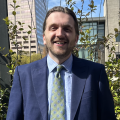
It’s official. Nathaniel VerGow — a senior leader at Los Angeles’ homelessness agency — will be the new director of Multnomah County’s Homeless Services Department.
The Multnomah County Board of Commissioners voted 3 to 2 on Thursday to approve VerGow, with two commissioners expressing hesitation.
“I think this is a really challenging time to appoint a new permanent director, when the direction from a new chair may look very different than the current direction,” said Commissioner Shannon Singleton, who in February announced her plan to run for the soon-to-be-vacated seat. “So, for that and that alone, I may be a ‘No’ vote today.”
Commissioners Meghan Moyer and Julia Brim-Edwards praised VerGow’s record, as did Chair Jessica Vega Pederson. Brim-Edwards has also said she will run for county chair. Vega Pederson has said she will not seek re-election.
VerGow said his goals would be understanding the local context, showcasing data to illustrate the agency’s work and improving how the department moves people from homelessness into housing.
In a brief statement to Street Roots, he added that, while budget issues will be challenging, his “key goal” is getting people into permanent housing and support services.
“I’ll be looking for opportunities to increase efficiency, reduce service duplication and improve outcomes, all with a focus on racial equity and participant service,” he added.
Into the fire
VerGow will take over one of the most important jobs in the county at a time when homelessness is increasing, the department faces an $87 million budget shortfall and the Portland area has seen a wave of recent shelter closures.
The city, county and state all face significant budget shortfalls, caused by a mixture of paying for programs with temporary funding and the impacts of President Donald Trump’s policies.
VerGow’s hiring also comes as the city and county wage an increasingly public battle over the best way to fight homelessness.
“I am very excited to have you coming on board,” Vega Pederson said. “We are lucky here that we have the Supportive Housing Services measure as a revenue source, even in light of what’s happening at the federal level or the state revenues. However, we’re living in a new normal with those dollars, and really having to understand what our system needs to look like with the resources that we have.”
VerGow declined to answer a list of questions or be interviewed for this story, instead pointing Street Roots to the county’s media office.
The county touted VerGow’s achievements in its announcement of his selection. Following questions from Street Roots, it provided detailed examples and data backing up VerGow’s qualifications.
For example, the release highlighted how VerGow managed an increase in shelter beds. The number grew from about 16,000 in 2019 to about 25,000 in 2021.
The last decade of VerGow’s work created a large public footprint online. Street Roots reviewed more than four dozen public meeting minutes and agendas, grant applications, reports, presentations, conference schedules and media appearances dating back to 2015.
The material shows the former social worker has spent much of the last decade deep in the details and execution of policies to house people experiencing homelessness.
VerGow has been a fixture at meetings held by L.A. county and city, regional commissions and even neighborhoods, updating elected officials and the public about how countless social programs were working, or explaining how they operate more broadly.
His footprint also shows he has a long record of advocating for housing first and harm reduction policies, as well as targeted outreach that meets homeless people where they’re at.
But VerGow’s move comes as his longtime employer is imploding after critical audits and is set to be investigated by the Trump administration for fraud.
At the March 9 meeting, Brim-Edwards asked VerGow about a separate instance of fraud his employer was involved in. He responded that his employer reported the fraud when they caught it.
How he got his start
VerGow graduated from New York state’s Hamilton College in 1995 with a Bachelor of Arts in French language and literature, his LinkedIn profile shows.
By 2000, he was working as a social worker in San Francisco’s Tenderloin neighborhood. After three years, the service provider promoted him to program director. He held that job until fall 2005, also completing a master’s of public health from San Francisco State University during that time.
Then VerGow stepped away from work, spending the next six years as full-time father to his three children. He returned to the workforce in 2012, working in health insurance until 2014, when he rejoined the world of social work, that time at LA Family Housing.
Stephanie Klasky-Gamer has been executive director of the giant housing and development nonprofit for nearly 20 years, including when VerGow worked there.
“He’s an incredible systems thinker and team partner,” she said. “He’s also just a very kind human. So it’s good, when you do work that’s really hard, that you respect the people that you work with.”
VerGow spent three years there, working as a case manager, then as outreach and assessment manager.
“I think Nathaniel is someone who always stays really grounded in mission and purpose and has a true sense of empathy for who we serve,” Klasky-Gamer said. “And it plays out in how we deliver services to our participants.”
He joined the organization at a time when its tax records show it was significantly expanding. Klasky-Gamer said VerGow was “instrumental” in sharing the organization’s practices with other organizations. Klasky-Gamer said that changed how the industry operated around L.A.
One example she gave was how the nonprofit organized service provider teams around the type of service provided, not the population served. That practice caught on in the system as a whole, she said, including at the Los Angeles Homeless Services Authority.
In the hotseat at the executive level
In late 2016, VerGow was hired as Director of Homeless Services for LAHSA.
The joint L.A. city and county agency was created in 1993 to address the problems of homelessness in the L.A. area, while promoting collaboration between the two governments. It is the region’s main homelessness agency, and has a yearly budget of $829 million.
A 2019 presentation he gave while in the role highlights his support for harm reduction approaches to housing people. The slides first explain the philosophy for meeting people where they’re at to provide services (as opposed to requiring sobriety before helping people).
The presentation’s final 10 takeaways finish with the following:
Drug users deserve access to quality care (health, mental health, and housing)
Drug users deserve help to be healthy (as healthy as possible) and happy
Drug users can be housed successfully
Homelessness surged in the L.A. area between 2015 and 2020, and VerGow acknowledged to a reporter there simply wasn’t enough housing.
During that period, an average of 207 people in L.A. County exited homelessness every day while 227 became homeless, 2020 data showed. That year, he authored a brief report to the L.A. City Council on the best ways to handle homeless people’s belongings without further traumatizing them as they transition into housing.
Then COVID-19 hit, and California became the first state to secure federal approval to house homeless people in hotels.
VerGow had recently been promoted to interim chief program officer, one of two second-in-command positions at LAHSA. Project Roomkey, similar to Portland’s Project Turnkey, became LAHSA’s responsibility in the L.A. area.
In late 2020, LAHSA hired a replacement chief program officer, and VerGow moved into the role of deputy chief program officer, three layers from the CEO.
By fall 2022, Project Roomkey was set to lose federal funding. Meeting agendas and news reports from the time show VerGow was responsible for explaining how LAHSA was rehousing people who had lived in the motels.
But the agency had pivoted to other strategies to address homelessness.
Successes
Julia Comnes, a Multnomah County HSD spokesperson, said he was tasked with implementing tiny homes and a similar motel program. Another approach was using state “Encampment Resolution Funding” to get people out of encampments and into housing.
Documents show VerGow was the lead on a nearly $14 million grant LAHSA submitted in 2023. The project sought to house about 200 people living along a 4-mile stretch of freeway in L.A. before the end of the grant period on June 30.
But it surpassed that goal by the end of 2024, the state’s 2025 annual report for the program shows.
During that time, outreach teams had housed 210 people in interim housing and 236 people in permanent housing. Only 34 people were currently living at the encampment. The report said that while they had already succeeded, they would continue housing people, providing substance use support and helping people secure housing documentation like ID cards.
The state review found another project VerGow led — this time on L.A.’s Skid Row — saw similar results. Noting it reduced unsheltered homelessness by 47% in women, the report concluded the success “gives us incredibly strong evidence that location based, and even subpopulation focused, interventions can overcome the rate of inflow into an encampment like Skid Row.”
(It is not clear what other factors may have also impacted the decreases.)
LAHSA had also put another strategy to use. Time-limited subsidies, which is often called rapid rehousing, puts people experiencing homelessness into market-rate housing, with government funding covering a portion of the rent for up to two years.
The approach represented 64% of the long-term housing beds in L.A. County in 2019, said a 2024 UCLA magazine profile of the strategy that quoted VerGow. The strategy went on to become a favored tool for L.A.’s new mayor in 2023, the story reported.
VerGow would spend the next couple years presenting on the strategy.
During that time, however, LAHSA would be rocked by controversy.
Controversies
In 2024 and 2025, the agency was hit with critical audits that drew widespread media attention.
“Homeless services provided by (LAHSA) are disjointed and lack adequate data systems and financial controls to monitor contracts for compliance and performance, leaving the system vulnerable to waste and fraud,” wrote the Los Angeles Times about the 2025 audit.
Critics didn’t waste time. On April 1 last year, the L.A. County Board of Supervisors voted to pull resources out of the joint agency to form a new one. That took more than $300 million in funding and over 700 employees.
VerGow fought the move in the hearing, explaining he was open to any approach that would bring the region closer to ending homelessness.
“However, what I don’t understand is the rush of the proposed strategy of moving all services with no real plan in place. A timeline is not a plan,” meeting transcripts show he said. “How can we expect that a new larger bureaucracy, built at a time of potentially reduced budgets, will yield significantly different results?”
In a twist of irony, LAHSA had been generating positive results in recent years, with homeless populations decreasing for two years in a row. Within days of the April 2025 vote, the head of LAHSA said she would resign, and a federal task force announced it would investigate the agency for fraud.
Portland lifeboat
Asked for a story that captures VerGow, his former boss, Klasky-Gamer, said she respects how he has handled himself this past year at LAHSA.
“The agency has gone through enormous transition the last 12 months, and he has composed himself throughout, staying focused on the role and responsibility of LAHSA, and ensuring that the work continues,” she said. “To me, he’s not the big gesture guy. He is the small moments of thoughtful, smart implementation.”
Documents show VerGow has indeed continued his day-to-day work.
In November 2025, he presented to L.A.’s Commission on Disability. In March, he presented to L.A. County’s Board of Supervisors on the partial defunding of the time-limited subsidy housing units that L.A. had touted years earlier.
At the end of that month, LAHSA missed a key deadline for a federally-required annual audit of the agency’s financial records, potentially putting its federal funding in jeopardy. Two days later — 366 days after Los Angeles County pulled resources from LAHSA — Multnomah County announced it had selected VerGow.
He starts May 4.
This article appears in April 15, 2026.