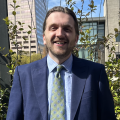
Nathaniel VerGow stepped into one of the region’s hardest jobs when he was approved to lead Multnomah County’s homelessness agency in April. Then it kept getting harder.
Just weeks after the ascendant former social worker started the job in May, he got a letter from a senior Trump administration official at the U.S. Department of Housing and Urban Development.
“I have directed my Office of Special Investigations to investigate the county for fair housing and other civil rights laws violations,” wrote Craig Trainor, HUD’s assistant secretary for fair housing.
The investigation is about the county’s criteria for deciding who gets federally and locally funded supportive housing.
Its assessment tool takes into account if someone requests services for LGBTQ people and/or people of color, among many other factors. Both groups are locally over-represented in local homeless populations.
(The county has said it complies with all Fair Housing Act and anti-discrimination laws.)
Then, just days later, HUD released new criteria for a key grant governments across the country count on for funding permanent housing with services for people who have experienced homelessness. It was dropping permanent supportive housing, as it is known, in favor of temporary housing models.
The announcement followed a monthslong court battle Oregon had joined over a previous attempt by HUD to make similar changes. A federal judge shot down both efforts. But the August decision’s implications are still unclear.
In the 2025 fiscal year, nearly one-quarter of permanent supportive housing in Multnomah County was funded by the grant, according to a report by the National Alliance to End Homelessness. It also found 1,005 people in the county stand to lose their housing because of the since-vetoed move.
And a few days later, the county finalized a budget that made tens of millions of dollars in cuts to homeless services due to budget shortfalls from things like falling tax revenue and the impacts of wide-ranging Trump administration funding cuts.
On top of all that, VerGow is managing conflicts between the city and county over how the region should fight homelessness. The county’s strategy prioritizes rent assistance and services over the shelters that Mayor Keith Wilson has made the centerpiece of his approach to homelessness.
Meanwhile, a multi-billion dollar homelessness funding crisis looms on the horizon as the 2030 end of the region’s Supportive Housing Services tax grows nearer. The ballot measure has been a resounding success around the tri-county region, but counties have come to depend on it for core functions.
Regardless of that success, declining public opinion means the effort to get a new ballot measure approved will be a tremendous uphill battle.
Street Roots joined VerGow at the county’s Northeast Portland offices to talk about how he plans to steer the county through the storm.
The following conversation has been edited for length and clarity.
Henry Brannan, Street Roots: First off, thank you for taking the time to do this.
Nathaniel VerGow: My pleasure.
Street Roots: Tell me a little bit about why you wanted the job.
Nathaniel VerGow: Well, this is work that I’ve been doing essentially my entire professional career, and this was an opportunity that really aligned well, both for me professionally and personally.
On the personal level, we’ve been looking to move to the Pacific Northwest for a while, and so the timing of this job opportunity was spot on for us in terms of becoming empty nesters, and so it really aligned perfectly in that respect.
It was also very much in alignment with my career goals and where I could see myself really making a difference.
I’ve been working in L.A. for more than 10 years, and had seen an arc of progress that had seemed to have reached a pinnacle and be descending as there was growing challenges politically with being able to make progress. And with the Olympics coming and an increasingly divisive political environment, there was limited enticement to remaining there and feeling like I could really make a significant difference in addressing homelessness for that community.
Portland, Multnomah County, on the other hand, while facing many of the same challenges in terms of budget and affordability and the ratio of incomes to the cost of housing and cost of living generally — you know, those are obvious, massive challenges.
But, with the fairly recent passage of the Supportive Housing Services tax measure that gave a strong infusion of funding, and what I’ve seen and read about the community as a whole — its values, and a real commitment to community and to the community members that are unhoused as well — it was a community that aligned with my values and where I felt like I could take my 20 plus years of experience and really make a difference, have an impact.
Street Roots: You had some really significant successes housing people during your time in L.A., but they happened at a time when there (were) ballooning homelessness budgets. Portland is currently facing, as you’ve mentioned, a time of rising homelessness and falling budgets. How do you plan to accomplish your goals under present conditions?
Nathaniel VerGow: Thanks for asking the easy questions. [Laughs.] That is the challenge of the moment, and it’s not a challenge that’s unique to Portland. We were facing shrinking budgets in Los Angeles. It’s an issue nationally, especially as the COVID-era funding is expiring or or being fully expended.
So across the board there’s shrinking budgets. Additionally, the economy at a national level is not doing well, and so tax revenue across the country is down. And so every community is struggling in a similar fashion. I think what we need to do here, really, is to be able to make progress in adjusting to the new norm relative to funding.
I think there are going to be a lot of hard conversations — that have already happened in just getting to this year’s budget — that are going to need to continue to happen as the fiscal reality for next year becomes clearer, and we struggle with those questions of ‘Do we fund the more for outreach, more for shelter, more for permanent housing,’ and ‘What is the appropriate balance there?’
In the end, what it all boils down to is ensuring that there’s maximum efficiency in not just the programs, but the connections of the programs that make a system. So that we can expedite the process of engaging with somebody who’s experiencing unsheltered homelessness, living in their car, on the verge of homelessness and get them through to stability in permanent housing as quickly as possible.
Because the faster we can make that journey for everybody, the better it is for each individual. There’s less trauma the shorter their experience of homelessness, and the more quickly we can get folks through that process, the more people we can serve in that same time frame.
The big focus I think initially is going to be looking at the connective tissue between the programs that exist, so that the pathways from outreach into shelter are as clear as possible, both for the providers as well as the participants, the community as a whole. And then the pathways and connections from shelter into permanent housing are also as clear and concise and efficient as possible.
One of the challenges that we have in human services is building systems that serve the majority in the most expeditious fashion, which is great in terms of maximizing public dollars, but the unintended side effect is that you then leave out the minority. And that, often in our society means BIPOC (Black, Indigenous and People of Color) folks but not always. Either way, regardless of who that minority is, we want to make sure that there are opportunities for everybody, and that we’re not excluding access to these resources for anybody.
Street Roots: Well, you’ve stolen my next question about efficiency. So to hop on past that, the Supportive Housing Services tax makes up about 60% of HSD’s budget and is set to expire in 2030. Yet polling shows the public is skeptical. Last month, you told me it would be “catastrophic” if it expired. Tell me a bit about the county’s work to win over voters.
Nathaniel VerGow: So my keyword, my mantra for the year I’ve been sharing broadly is accountability.
And what I mean by that is that we — as the contractors and and managers of the the contract work — have a responsibility to make sure that we are being good stewards of public funds, and so that we have clear contracts with clear deliverables that we can hold our providers accountable to, to make sure that they are being good stewards of public funds and using those dollars to the maximum efficiency and effectiveness.
We also have to be accountable to those providers to make sure we are being good partners in getting contracts to them in a timely fashion. So it’s a mutual accountability that we want to ensure. And then collectively — the service providers, the community-based organizations that provide the services, the homeless services department — collectively, we have to be accountable to the general public.
And that is all of the constituents. That’s our elected officials. That’s the voters, that is the random person walking by on the street that is a citizen of this county. And so part of that public accountability is being able to show that we are being accountable in those other two ways that I first named, and then also being able to show through data how the programs are being effective.
And we have decent dashboards already on our website, but we also have an important initiative underway right now where we are transitioning to a new database system. It will allow us to be more efficient and effective in collecting data from our providers because it’s a much better user interface.
We’re mapping out what that system is going to look like, so as to be able to ensure that we can track the metrics that will be able to show us how effective our programs are, and how effective those connected mechanisms are between programs.
So it’s not just hoping that folks will take the time to go find our website and look at our dashboards and do the interpretation themselves, but that we are getting out in the public and talking about the progress that’s being made, as well as the challenges.
I don’t think there’s anybody that can walk down the street and see what I see every day — of people experiencing homelessness on the sidewalk — and then hear us talk about all the successes we’re having, and feel that there’s consistency there.
What we’re seeing (as county residents) doesn’t necessarily jive with what folks are hearing around the message of success, because the fact of the matter is our successes are not successful enough to end homelessness.
And that’s because of all the contributing factors to homelessness that are driving people into homelessness on a daily basis. We’re seeing greater inflow into homelessness than we’re able to place people out of homelessness and into permanent housing.
And so we need to be able to talk about the complexities, acknowledge the impact that homelessness has — most importantly on the people experiencing homelessness — and refocus all of us on the real human impact that is at the heart of this issue. But also recognize and acknowledge the frustration that the general public has that they hear that there’s a tax.
It may not actually be a tax that they are experiencing because it is based on income level, and it’s just the very high end of our tax bracket that are taxed through the Support Housing Services tax. So they may not even be directly paying for it, but they hear about a tax, and are not seeing, necessarily, the progress that they would expect.
And so we need to be able to be clear with the public about the complexities of the issues, where we are having success, where we are experiencing challenges, what we’re doing to make improvements in our response, and also reminding folks of what we need from them as they go to the ballot box
Street Roots: You talked about accountability, and I think that word implies that the county or you have done something wrong. Accountability for a mistake. Is that what you mean by accountability? And if so, are there specific mistakes that you’re thinking of that you want to be accountable for? Or, are you talking more about transparency with the behind the scenes like machinations of how this (system) works?
Nathaniel VerGow: It was not a thought of specific mistakes. It is the fact that this is a complex issue, and so not every move is going to have the perfect results. And so we want to be able to own up when a program is not as successful as we would have hoped, and that we are being transparent.
It is absolutely transparency. It’s being very clear about what we are doing, what we are doing to hold ourselves accountable, to hold our providers accountable, to show that we are being responsible and good stewards of of the public funds — and owning up to where where things can be improved, and talking about what we are doing to improve them.
If we were doing this perfectly and had all of the funds we needed, we would be solving this.
And there are both issues involved. There are improvements that we can make in how we are providing services, and we don’t have enough funds. And I think it’s important to be able to share that it’s a ‘Both and’ challenge here. We do need to do more with less because we have less funding. But we still need to be very clear that there is more funding needed if we’re really going to end homelessness here in the county.
Street Roots: Do people in the region need to get more realistic about the fact– basically adjusting their expectations of what is possible with the current level of funding and then get more realistic that to flip inflow-outflow — to house more people than economic conditions are pushing into homelessness — there will indeed require more money? It sounds like you’re saying that indeed people do need to get, these weren’t your words, but people will need to get more realistic.
Nathaniel VerGow: The way you describe that, I’m concerned about the framing of ‘Folks need to get realistic’ because as you were saying that my brain went to ‘Folks need to adjust that this is just going to continue.’
And to me, that is a total failure for all of us if people accept that homelessness is going to be a part of our lives and that we just need to live with it because then we get immune to seeing the human suffering that surrounds us, and we are far too adaptable in that way.
I think all of us, to some extent, get immune to the fact that when we walk by and see a person hunched over, potentially in real need of medical assistance, we don’t think about it. We just continue to walk by, and becoming immune to that level of human suffering I think is incredibly detrimental to our community.
So I don’t think that’s at all what you intended, but I do want to make sure that as we’re talking about it that we are centering the humans that are suffering as a result of this.
Having said that, yes. We are in a new financial reality.
And so there are going to be challenges to be making progress. Especially with any dramatic increase in the pace of progress, that is going to be exceptionally challenging. It is going to be largely refinement of what we are doing, and working to eke out every measure of incremental progress that we can.
And again, I think it’s important for your readers to understand that it is– I describe homelessness as we’re sitting in a canoe at the bottom of a waterfall, and the budgets that we’re provided give us either a solo cup, a big plastic cup, a gallon jug, or maybe just a paper Dixie cup that has two ounces to bail ourselves and keep ourselves afloat. And, even with a gallon jug, if the flow of the waterfall is too significant, that canoe is going to sink.
So it has to be a ‘Both and’ of funding for the response at the bottom of the waterfall as well as work above the waterfall to stem the tide. And what I mean by the stemming of the tide is investments in prevention dollars, but it’s about setting living wages. It’s about ensuring that there’s sufficient development of affordable housing at the appropriate affordability levels. So it’s not just building more affordable housing at a 60% area median income level, which sets rents just barely below what market rents are. We need deeply affordable housing.
What I was looking for was a sheet that has specific data around the number of affordable units that are needed here in Multnomah County just to meet the current need, and it’s staggering.
And so if we’re not approaching the problem holistically, we’re not going to find a complete solution. We’re going to address the symptoms, not necessarily finding the root cause and or cure for this.
It is a very complex issue. Homelessness is not just one piece. It is not that somebody has made bad mistakes and just needs to correct those mistakes and pull themselves up by their bootstraps. It’s not just addiction. It’s not just mental health. It’s not just physical health. It’s not just economic. It is often some combination of a multitude of those, and it includes challenges in terms of the breakdown of family dynamics. It can include trauma in youth, whether that’s in the family or external trauma that somebody’s experienced. All of that contributes, in varying degrees, to somebody ending up on our street corner, living in a tent or not even having the cover of a tent.
Street Roots: You talked about how people get immune to the amazing extent of individual human suffering on the street. As I understand it, you work in Old Town often. Do you carry Narcan on you?
Nathaniel VerGow: I don’t at the moment. I’ve actually just had a conversation earlier this week, actually, with folks at the health department, so that I can.
That was a practice of mine in Los Angeles, and unfortunately (I) did have to use it on a number of occasions, just riding public transportation. So yes, I will be as soon as I make that connection, probably as soon as next week.
Street Roots: It seems that public opinion on how well local governments are doing in fighting homelessness really depends on how bad they think the crisis is, and regional research shows people’s understanding of homelessness is largely determined by unsheltered homelessness that they see firsthand.
So to me it seems like the county and the region at large is stuck in this three-part vicious cycle. First, homelessness is getting worse because the things that cause it are getting worse. Second, so, you need more money to make progress on fighting homelessness. And third, but, to get voters to approve that more funding, they need to see progress — which how are you going to make without more funding? What do you do?
Nathaniel VerGow: I think you’ve hit the nail on the head. I mean that’s what we’re trying to figure out.
The gigantic challenge in that is that the goals that were set forward with the initial funding of the SHS measure have been met almost across the board. If they haven’t yet, we’re just on the cusp of meeting them.
And to your point, homelessness has increased. Visible homelessness has has has remained. And so I can absolutely understand why the general public would be skeptical that there’s been a good use of those dollars.
The fact that we’ve housed more than 10,000 people with SHS dollars is phenomenal, and it gets back to what I was saying earlier: We can’t just talk about the progress that we’ve made. We can’t just say that we’ve been successful. Yes, we’ve met the goals. We need to set new goals.
And unfortunately the challenge is that to achieve some of those new goals does mean potentially more funding. Because a lot of what the SHS money is being used for is rental subsidies to keep people housed who would otherwise not be able to afford their housing and would end up back on the street.
So again, it gets back to the multitude of pieces that contribute to homelessness. Providing a housing voucher for somebody who is disabled and on a fixed income — and that fixed income is not sufficient to keep up with market rate housing — (they’re) going to need ongoing assistance, they may need ongoing services as well.
Either way, those are ongoing costs that we need to sustain if we are going to keep that household housed.
So either we pay for those through the homelessness system — or we get investments through bond measures or other vehicles to be able to build more deeply affordable housing — so that they could be paid for from a different pot of money. But either way, it’s adding to the funding. Whether it’s paying for more deeply affordable housing that we could potentially change the subsidy that’s helping them, or even move them into a different unit that could free up the SHS dollars to do something different. But either way, it is an additive.
Street Roots: I suppose the third option is that the region doesn’t fund it, allows people to go into homelessness and then incurs greater downstream costs. Is that the unsaid third option that could happen as well?
Nathaniel VerGow: It is, yes. It is one that I don’t think is palatable to anybody. So we tend to not name it. But yes, that is the result — if not for a renewal (of) the SHS measure.
Street Roots: You inherited some tricky challenges. Among them is the contentious relationship between the city and county? Where do things stand right now? And has the region’s budget situation and the onslaught of federal policies that impact the region, has that changed the relationship at all?
Nathaniel VerGow: My experience of the relationship between the city and the county is not one that is contentious.
I think there’s a need for healthy debate about policy and an approach to solutions. And so I don’t see having differences of opinion — and even vigorously debating those — as necessarily meaning that a relationship is contentious.
So I certainly wouldn’t characterize it as contentious. I think there are at times differences of opinions between our elected officials — not just between city and county, but city and state, county and state, certainly Multnomah County and the city relative to what is happening at the federal level.
There are also different levers around progress that different bodies have purview to impact. And so, I think that’s where the focus really needs to be: being very clear in our conversations about what are the levers that we can move to have impact. And then listening to each other about how collectively we think that those levers are going to have the greatest impact.
I do think that there’s room for increased collaboration. That is a key desire and goal of mine is to build deeper collaboration and coordination with the city. I would say that even if I walked in and folks were walking around hand in hand — there’s always a need for improved collaboration and coordination.
Street Roots: In addition to inheriting some challenges, you were also hit with some pretty rough ones. Back in May, HUD announced an investigation into how the county determines who gets supportive housing slots. How is this impacting the administration of this program? And how does the county deal with that additional complication in how it houses those populations that are disproportionately pushed into homelessness already, and now there’s this additional challenge, and a significant one?
Nathaniel VerGow: Yeah, there are challenges across the country right now around addressing inequities relative to race and ethnicity.
And part of what drew me to this job was the county’s commitment to equity and to ensuring that our systems that exist — that, let’s be honest, are designed by white people for white people — are sufficient to ensure (equity).
As we design systems, we design them for the majority. That is a lot of what is the basis of systemic racism, and so what we need to be focusing on is while we continue to make sure that we have maximum impact for the majority of people experiencing homelessness, that we’re not leaving out anybody on the margins.
We have to make sure that we are designing a system that can maximize access and expedience of solutions without creating barriers. So the fact that the Department of Justice sent that letter of inquiry to me just isn’t going to dramatically shift anything. The work is the work.
We need to make sure that we are able to serve people experiencing homelessness with an equity lens because homelessness is inequitable. Its impact is not equitable, and so we need to ensure that we are making certain that access to the resources and the housing is equitable.
That’s what we are called to do with the Fair Housing Act — ensure equity. And so that does not mean that we keep the systems that existed, that were designed for and by white people. It means that we need to amend and adjust, and ensure that we have services that can serve the people who are experiencing homelessness in our community, and that is disproportionately people of color.
Street Roots: Looking to some more recent actions from HUD, how is the county planning to deal with changes to the Continuum of Care grant that, as I understand it, largely abandoned permanent supportive housing, housing first approaches, harm reduction, and other things that you’ve really brought forward throughout your career? What’s going to happen to local permanent supportive housing funding?
Nathaniel VerGow: As you pointed out, it was a virtually complete pivot away from a focus on permanent housing to supportive services programs and temporary assistance programs.
And in the publications and webinars from HUD, there was very clear messaging that the Trump administration thinks that far too many people are just reliant on federal resources and really just need to go out and get a job and get treatment.
Data says otherwise. And we’re focused on ensuring that our programs are data driven. So we will continue to do so.
What that means practically is– well, let me back up: It’s important to note that there was a lawsuit against that (2025) Notice of Funding (Opportunity) that essentially prevailed earlier this summer. So that was not allowed to proceed.
The new Notice of Funding (Opportunity) that was released back in (June), while it still has those policy priorities, is not as punitive as the prior notice of funding was. So, in the prior one, there was an explicit cap on how much money could go to permanent housing that has been removed in this notice.
What is still in existence in this notice is a cap on ‘standard renewals.’ So that will mean that 40% of the programs that have been funded through HUD funding will have to be competed for nationally.
In prior years, for quite a while, (funding for) the ‘Tier 1’ renewals — that are not guaranteed, but are a virtual guarantee renewal — has been allocated to be approximately 90% or even higher of the annual renewal. This year, it was capped at 60%. So that puts a significant amount of funding potentially at risk.
We worked as a community with our Continuum of Care Board and have prioritized that our permanent supportive housing programs would remain in ‘Tier 1.’ And fortunately, that means that because that is a 60% cap, we’re fortunate enough that that covers pretty much all of our permanent supportive housing projects.
What will be in jeopardy are rapid rehousing programs. And rapid rehousing is a shorter-term assistance and services. So it’s financial assistance for up to 24 months with services to help folks stabilize and increase their income and be able to take over a market rate unit.
That is considered permanent housing, and so that was part of the 60% cap. So we’ve worked with our providers locally to pivot those programs to become transitional housing programs, which are relatively similar.
But the biggest difference between a transitional housing program and a rapid rehousing program is that the participant is not actually a tenant in the program; they are a program participant and don’t have tenancy rights. And so, at the end of the up to two years in that program, we are then having to go find that tenant permanent housing still.
And so, it is sort of an amalgamation of shelter and a program similar to rapid rehousing. There are a lot of requirements that have been put forward relative to transitional housing, and there’s been very clear language that HUD is prioritizing programs that are focused on substance use recovery specifically, as well as employment programs and outreach.
So it is changing the landscape of what will be funded by the federal government.
I will note also, though, that there is a lawsuit pending about this Notice of Funding (Opportunity) as well, and my understanding is that there was an ask for the court to take action as soon as next Monday (8/10/2026), and so we’ll see what what happens with that.
(Editor’s note: A federal judge blocked the 2026 NOFO. The county said it is unclear what HUD will do next or how that will impact them. But it is likely HUD will try to move away from housing first approaches again.)

Subscribe to our newsletter
Stay in the know and get Street Roots’ journalism straight to your inbox.
Street Roots: We’re getting near the end–
Nathaniel VerGow: If I can please just add one more thing while you’re looking at the next questions.
I do want to make sure that the public is clear that the way this Notice of Funding (Opportunity) is set up, also allows HUD a lot of leeway to be subjective in how they are doing that competition. And so there is really significant risk still for us as a community.
And so the conversation we’ve been having thus far is largely focused on the impact of how we’re going to make progress, despite decreasing budgets; this could be another severe blow to our budgets.
It’s upwards of $15 (million) to $20 million of funding that could be at risk if the Trump administration exercises the subjectivity that they’ve built into the Notice of Funding (Opportunity) and chooses not to fund us locally.
(Editor’s note: The county said it is unclear how the recent ruling on the program will impact this.)
Street Roots: The Trump administration previously — when there’s been that type of subjectivity built in or when there hasn’t — has moved funding around from blue states to red states. You can see that specifically in Army Corps of Engineer funding in previous fiscal years. Is that something that you’re anticipating having to contend with in this situation?
Nathaniel VerGow: It is absolutely a concern.
Street Roots: How would the county respond?
Nathaniel VerGow: If that comes to fruition, we’ll have to have some very hard conversations locally and with the state about the impacts of those losses.
And those won’t just be losses here in Multnomah County. If HUD does move in that way, that will mean significant impacts in– I mean across the state of Oregon, and as well as in a number of states and certainly in major cities across the country.
In terms of how we will deal with it here; those are going to be really hard conversations that we will have to have of ‘How are we going to address a $10 (million) to $20 million loss of funding, and it will be similar conversations that we had to have during last year’s budget cycle of ‘What are our priorities as a community, how do we think that we can use the funding that we have remaining to its maximum effectiveness?’
And really, budgets are always value conversations, and so that will be the work over the winter.
Street Roots: Looking to the future, what’s the range of scenarios for homelessness in the next year or so, and crucially, what things will make the difference between the ideal outcomes and the much worse outcomes?
Nathaniel VerGow: Public investment is the biggest.
We’ve seen — over, certainly the last couple of years, and during the prior Trump administration — an active movement to defund the public sector.
It started in this term with the activities of DOGE (the ‘Department of Government Efficiency’) of really purging the federal government, and we’re already seeing those impacts through the explosion of measles and the foodborne illnesses. And so yes, homelessness and housing impacts are likely to follow in a similar path.
Street Roots: it’s a pretty significant list of challenges you inherited. It’s a pretty significant list of challenges that have happened since you started. And it was a hard job to begin with. Your job is to house people, and with the resources presently available, it’s changing that ratio– I guess what I’m asking here is–
Nathaniel VerGow: Why do I bang my head against the walls? [Laughs]
Street Roots: How do you feel when you go home at night? How do you feel day-to-day, and what do you wish people understood about the work that you and your colleagues do?
Nathaniel VerGow: I would say I think a lot of people see how challenging the work is.
I’ve had a number of people ask me ‘Why did you take that job?’ in that tone, and you’ll have to figure out how to describe that tone in writing. (Reporter’s note: The tone was quite incredulous.)
This is not easy work. It’s not easy work at the policy level, at an administrative level and it is absolutely incredibly challenging work at the direct service level.
I’ve made this my life’s work. So just because it is getting harder, doesn’t mean that I am going to back away from it. Frankly, it just increases my resolve to figure out how we can make progress.
We may, as a society, disinvest in solutions. That doesn’t mean there aren’t people who are committed to making progress and to helping as many lives as we possibly can. And that is the work that my colleagues, that the agencies that we fund, that their staff do day in and day out. It is challenging. It is traumatic at times. It is epically rewarding on an emotional and spiritual level.
And there are definitely nights when I go home and am tempted to cry, or just need to go for a long run — or have a hard workout, or get out on a paddleboard, or get on my motorcycle and find some way to just zone in and meditate and forget — to center myself.
But it is rewarding work. I am doing everything I can on a day-to-day basis — as are we all in this work — to improve the lives of people who have been neglected, forgotten, chastised, dehumanized by our society, and I can’t think of a better way to spend my days.
This article appears in August 12, 2026.